
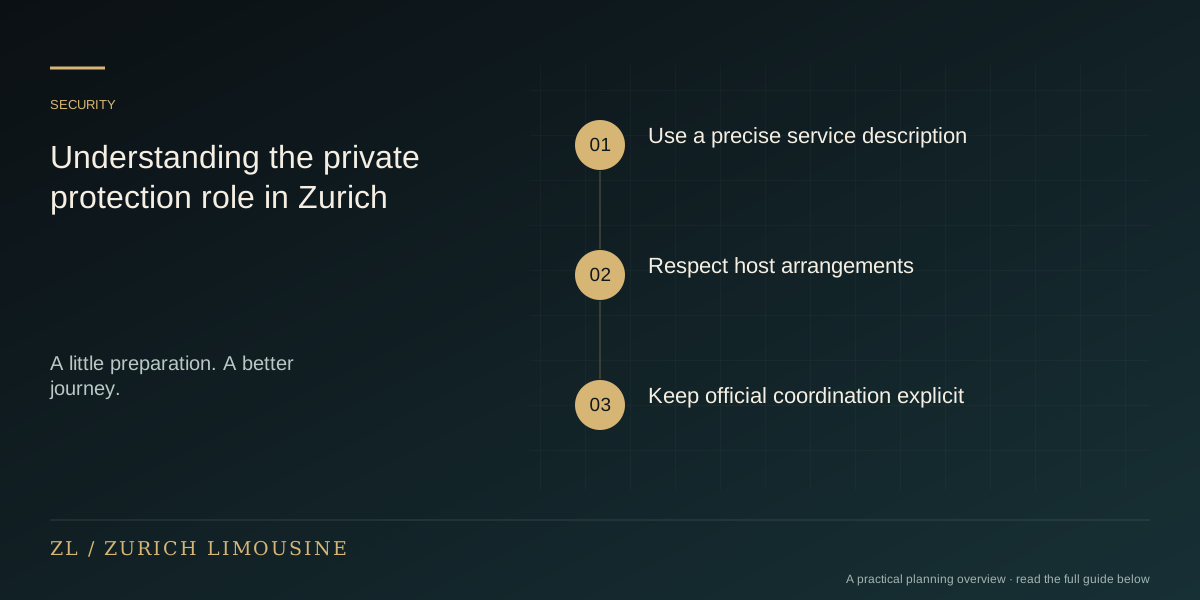
Use a precise service description
Describe the requested personal accompaniment, coordination and agreed presence in ordinary language. Avoid labels that imply a government role or unrestricted authority. The provider should confirm the duties it accepts, and the client should assess that written scope rather than infer capabilities from a uniform, photograph or impressive-sounding title. This makes it easier for procurement staff to compare the offer with the actual support requested by the visiting executive.
Respect host arrangements
Offices, hotels and event organisers determine their own visitor procedures. A private booking does not by itself resolve admission or special access. Ask the responsible host to confirm arrangements for accompanying personnel, and refer any official or restricted-access request to the appropriate authorised organisation for review. Where several venues are involved, confirm their arrangements individually rather than relying on the status of the principal’s invitation.
Keep official coordination explicit
If the assignment involves an official delegation or a programme led by public bodies, identify the authorised coordinating team. Any private role must be agreed within that programme. Do not imply that paying an hourly rate grants powers, credentials or permissions that have not been confirmed through the responsible process. The client’s final itinerary should describe the private role accurately so hosts do not receive an exaggerated account of its authority.
Check claims before booking
Ask for evidence relevant to the actual service and follow the client’s normal supplier-review process. A general website article is not proof of a particular licence, qualification or official endorsement. Keep the final offer specific about accepted duties, personnel hours and separate transport, without promises of eliminating every possible risk. If a specific capability is essential, make it an explicit review question before approving the visit rather than an unstated expectation.