
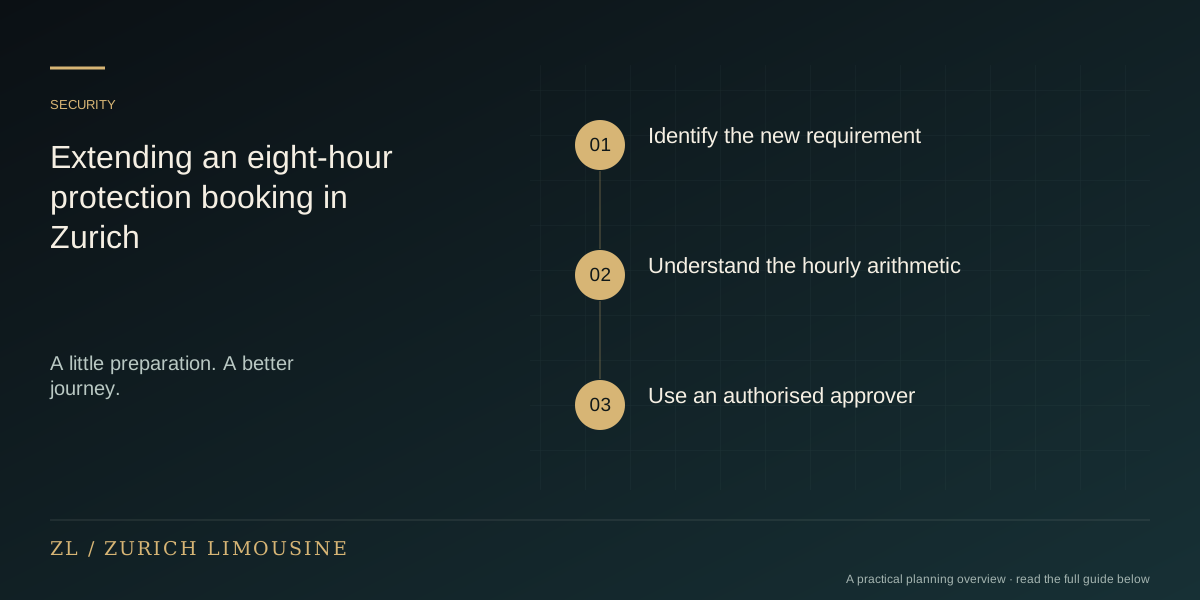
Identify the new requirement
State the revised finish, additional location and activities requiring support. A vague message saying the evening may run late does not define an extension. The provider needs enough information to review availability and scope, while the client needs to know whether the requested change has actually been accepted. If the new activity involves a different venue, include its contact and any accompaniment permission already obtained from the host.
Understand the hourly arithmetic
At the published personnel rate, one additional agreed hour for one guard is CHF65. Two additional agreed hours for one guard are CHF130. The provider should confirm the revised service period and any applicable conditions; the arithmetic does not itself guarantee availability or settle unconfirmed arrangements for partial hours or other expenses. For example, an accepted ten-hour assignment for one guard has a basic personnel calculation of CHF650 before separate services.
Use an authorised approver
Nominate someone who can approve the additional personnel charge while the principal is occupied. Record the approval through the agreed booking channel and ask for acknowledgement. This avoids asking the guard to negotiate commercial decisions with several people who may have different understandings of the company’s budget or authority. If the usual approver becomes unavailable, use the named backup rather than treating an unanswered message as permission to proceed.
Update the separate transport
A limousine retained for the original programme may have its own availability and charging arrangements. Send the revised timing to the transport coordinator and obtain confirmation separately. Keep the personnel and vehicle records aligned so the principal does not receive one confirmed extension while another essential part of the journey remains unconfirmed. An assistant should be able to identify both accepted extensions without searching through several disconnected conversations during the meeting.